
Today’s wineries are no longer solely production facilities—they are cultural destinations. As hospitality becomes increasingly central to the wine experience, contemporary winery architecture must support both operational performance and guest expectations.
Napa Valley Winery was designed with this dual purpose: to integrate winemaking craft with thoughtfully composed spaces that elevate hospitality, atmosphere, and connection to the landscape.
A Design Shaped by Artistic Perspective
Rather than approaching this project through traditional winery typologies, the design evolved in close collaboration with a client deeply immersed in contemporary art. From the outset, we explored architecture not merely as shelter for activities but as a spatial expression of experience. This perspective informed every decision, from form and materials to light and sequence.
Our goal was a building that engages the senses and creates a memory of place—where architecture and art coexist in service of both function and experience.
Evolving the “Cave” Through Form and Material
Historically, winery architecture has leaned on subterranean spaces—caves and cellars—that offer natural temperature control and a timeless quality. Here, we reinterpreted that tradition through above-grade concrete masses that serve both structural and environmental roles.
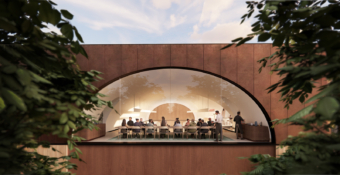
Exposed, thick concrete walls provide thermal mass, structural stability, and a tactile presence. In contrast, copper cladding wraps portions of the exterior, selected for its rich finish and ability to age gracefully over time. As the copper patinates, it deepens the building’s relationship to the seasonal landscape and vineyard cycles.
This pairing of materials reflects a restrained palette rooted in craft and endurance, with an intentional focus on quality and longevity.
Light, Sequence, and Spatial Experience
In this winery, daylight becomes a defining design element. Rather than flooding interiors with broad glazing, we introduced daylight through high clerestories and slender slot openings, creating a dynamic play of light and shadow. These moments shape the spatial progression, guiding visitors from entry through production to hospitality spaces.
Views are considered and framed—each opening aligns with vineyard vistas or distant hills, reinforcing visitors’ connection to both place and process.

Seamless Integration of Production and Hospitality
At the core of the building lies the fermentation and processing space—efficient yet deliberately composed. Large, operable openings allow the space to adapt during harvest while maintaining clarity. Adjacent to production, a 2,700-square-foot hospitality space invites guests into an environment where spatial openness, landscape connection, and architectural restraint support an elevated wine experience. From the production space sliding wood doors open to a terrace planted with drought-tolerant species, dissolving the boundary between interior and landscape.
By organizing programmatic flow from production to hospitality, the design reinforces the evolving role of winery spaces: hospitality is no longer secondary—it is fundamental to brand identity and guest engagement.
Sustainability Through Simplicity and Performance
Sustainability in this project stems from thoughtful restraint rather than technological excess.
- Concrete walls contribute to passive thermal regulation.
- Natural ventilation is supported through operable openings.
- Durable, locally appropriate materials reduce maintenance over the building’s lifespan.
- The landscape design prioritizes ecological resilience and water efficiency.
These strategies work quietly within the architecture to support environmental performance and operational longevity.
A Cohesive Architectural Narrative
What distinguishes this Napa Valley project is its clarity of intent: a winery that acknowledges and enhances the winemaking process while creating spaces that resonate with hospitality, craft, and landscape. Rather than relying on gesture, the design achieves impact through proportion, material integrity, and spatial progression—each element contributing to a whole that is both functional and evocative.
As the wine industry continues to emphasize guest experience and hospitality-driven design, architecture plays an increasingly critical role in shaping place, brand, and lasting connection.
Explore the project here. If you’re envisioning a winery or hospitality environment of your own, we’d welcome the opportunity to begin the conversation.